


Crypto wallets vs exchanges is a choice a lot of casino players make without really thinking about it. Funds are often already sitting on an exchange, and sending crypto feels the same no matter where it’s going. Once gambling is involved, though, that convenience can cause real problems.
Exchanges and wallets work very differently once gambling is involved. What looks like a simple transfer can turn into delayed deposits, stuck withdrawals, or funds that can’t be recovered at all. In many cases, neither the casino nor the exchange can fix it once it’s happened.
This guide looks at exchanges and wallets specifically through the lens of crypto casino use. We’ll explain how each one works in practice, why casinos usually require wallets, what goes wrong when exchanges are used incorrectly, and how to avoid the most common mistakes players make when moving funds to and from gambling sites.
Crypto Wallets vs Exchanges for Casino Use
At a basic level, crypto wallets and crypto exchanges both let you send and receive cryptocurrency. That’s where the similarity ends once casinos are involved.
A crypto wallet is designed to give you direct control over your funds. When you send crypto from a wallet, the transaction comes straight from an address you own. Casinos can see where the funds came from, link the transaction to your account, and credit it without relying on a third party.
A crypto exchange works differently. When you send funds from an exchange, you’re not sending them directly from a wallet you control. You’re asking the exchange to send them on your behalf. The address used often belongs to the exchange, not you, and in many cases it’s shared between thousands of users.
This distinction matters more than most players realise. Casinos are set up to interact with personal wallet addresses, not pooled exchange accounts. When a transfer comes from an exchange, it can create confusion around ownership, timing, and transaction tracking.
That’s why many crypto casinos strongly recommend, or outright require, using a wallet instead of an exchange account. It’s not about preference. It’s about making sure deposits and withdrawals can be properly identified and processed without issues.
Why Crypto Casinos Require Wallets, Not Exchange Accounts
Crypto casinos don’t ask players to use wallets just for convenience. In most cases, it’s a requirement built into how deposits and withdrawals are tracked.
When a player uses a personal wallet, the casino can clearly see where the funds came from and where they’re going back to. Each transaction is tied to a single address the player controls. That makes it straightforward to credit deposits, process withdrawals, and resolve issues if something goes wrong.
Exchange accounts complicate that process. Transactions sent from exchanges often come from pooled addresses shared by many users. From the casino’s point of view, it’s not always clear who actually owns the funds once they arrive. If something doesn’t line up, the casino has no way to separate one player’s transfer from another’s.
There’s also the issue of control. When you send crypto from a wallet, you control the transaction from start to finish. With an exchange, the platform sits in the middle. If the exchange delays, batches, or flags a transfer, the casino can’t do anything about it.
This is why many crypto casinos warn against using exchange accounts for deposits or withdrawals. If funds are delayed, miscredited, or rejected, support teams often have limited ability to help. Using a wallet removes that extra layer and keeps the transaction between you and the casino.
Custodial vs Non-Custodial Control in Crypto Casinos
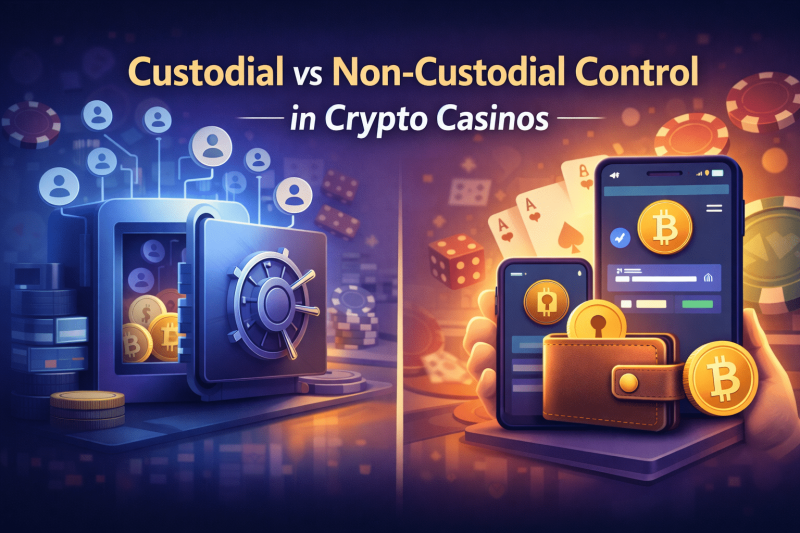
When it comes to using crypto casinos, the difference between custodial and non-custodial setups isn’t theoretical. It directly affects how deposits are credited, how withdrawals are processed, and what happens if something goes wrong.
The key question is simple: who actually controls the funds during the transaction. With casinos, that distinction matters more than most players expect.
Custodial (Exchange-Controlled Funds)
Custodial setups are what you get with crypto exchanges. The exchange holds the private keys and manages transactions on your behalf. When you send funds to a casino, you’re not sending them directly. You’re requesting that the exchange send them for you.
This introduces an extra layer into the process. Withdrawals may be batched with other users, delayed for internal checks, or flagged automatically based on the destination. From the casino’s side, the transaction often appears to come from an exchange-owned address, rather than an address tied to you as an individual.
That’s where problems tend to start. If a deposit is delayed or a withdrawal doesn’t arrive, the casino can usually confirm that the transaction was sent or received on-chain. Beyond that, they have no visibility into what the exchange does internally. Support often ends with being told to contact the exchange instead.
Custodial accounts are convenient for trading, but they add uncertainty when used for gambling. You’re relying on a third party that the casino can’t coordinate with or override.
Non-Custodial (Wallet-Controlled Funds)
Non-custodial wallets work differently. You control the private keys, and transactions are signed and sent directly by you. When you deposit to a casino, the funds come straight from an address you own, and when you withdraw, they go back the same way.
From a casino’s perspective, this is the simplest setup. Deposits can be matched to your account without ambiguity, and withdrawals don’t depend on any outside platform. If there’s an issue, both you and the casino are looking at the same on-chain transaction data.
Non-custodial wallets don’t remove all risk, but they do remove unnecessary complexity. There’s no exchange in the middle deciding when or how a transfer should be processed. That’s why most crypto casinos recommend wallets for regular play and treat them as the default option.
How Deposits and Withdrawals Behave When Using Wallets vs Exchanges

The difference between wallets and exchanges becomes most obvious once you start moving funds in and out of a crypto casino. On the surface, both involve sending crypto from one address to another, but the way those transactions are handled is very different.
Where the funds come from, who controls the transaction, and how many systems sit in the middle all affect whether deposits credit quickly or withdrawals get stuck.
Using a Wallet for Casino Deposits and Withdrawals
When you use a personal wallet, deposits usually credit more cleanly. The transaction comes from an address you control, hits the casino’s deposit address, and can be tracked end to end on the blockchain. Once the required confirmations are met, the casino can credit your account without waiting on anyone else.
Withdrawals work the same way in reverse. The casino sends funds directly to your wallet address. There’s no batching, no internal processing layer, and no third party deciding when the transaction should be released.
If there’s a delay, it’s usually due to network congestion or confirmation times, not because the transaction is being held or reviewed off-chain. That predictability is why wallets tend to work better for regular casino play.
Using an Exchange for Casino Deposits and Withdrawals
Using an exchange account adds friction on both sides. Deposits sent from exchanges may arrive later than expected because withdrawals are often queued or bundled with other users’ transactions. In some cases, the exchange uses a shared address, which can make it harder for the casino to automatically recognise the deposit.
Withdrawals to exchanges can be even more problematic. Some exchanges flag gambling-related transactions for manual review, while others require additional information such as memos or internal tags. If anything is missing or delayed, the casino can usually only confirm that the withdrawal was sent.
What happens after that is out of the casino’s control. This is why players often experience smoother deposits and faster withdrawals when using wallets instead of exchanges. Fewer moving parts means fewer points where things can stall or fail.
Wallets vs Exchanges: Deposit and Withdrawal Behaviour Compared
The differences between wallets and exchanges are easier to see when you put them side by side. The table below focuses purely on how each one behaves when used with crypto casinos, not on trading or long-term storage.
| Feature | Using a Personal Wallet | Using an Exchange Account |
| Deposit crediting | Usually automatic after confirmations | Can be delayed or require manual review |
| Withdrawal processing | Sent directly to your address | May be queued, batched, or flagged |
| Address ownership | Unique address you control | Often shared or exchange-owned |
| Casino visibility | Clear, end-to-end on-chain tracking | Limited once funds reach the exchange |
| Risk of missing funds | Low if details are correct | Higher if memos, tags, or timing issues occur |
| Support resolution | Casino and player see the same data | Often redirected to exchange support |
Hot Wallets, Cold Wallets, and Exchange-Held Balances

Not all wallets behave the same way when you’re actively using crypto casinos. Some are built for frequent transactions, others are designed to stay offline most of the time. Exchanges sit somewhere else entirely, even though they often feel like a wallet at first glance.
Understanding how each one behaves helps avoid using the wrong tool for the job.
Hot Wallets (Best for Active Casino Play)
Hot wallets are wallets that stay connected to the internet. These include browser wallets, mobile wallets, and desktop wallets. For casino play, this is usually the most practical option.
Because hot wallets are always accessible, deposits and withdrawals tend to be quick and predictable. You control the address, you sign the transaction yourself, and the casino can interact with it directly. If something goes wrong, both sides are looking at the same on-chain data.
Most players who gamble regularly with crypto use a hot wallet for this reason. It’s not about maximum security. It’s about smooth, repeatable transactions without extra layers getting in the way.
Cold Wallets (Safer Storage, Less Convenient)
Cold wallets are designed to stay offline as much as possible. Hardware wallets fall into this category. They’re excellent for storage, but less convenient for frequent casino use.
Deposits and withdrawals still work, but every transaction requires connecting the device and manually approving it. That’s not a problem occasionally, but it can become tedious if you’re moving funds in and out often.
Some players keep most of their balance in a cold wallet and move smaller amounts into a hot wallet when they plan to play. That setup keeps long-term funds offline while still allowing smoother casino transactions when needed.
Exchange-Held Balances (Convenient, but Risky for Casinos)
Exchange balances aren’t wallets in the traditional sense. Even though they look like one in the interface, you don’t control the private keys or the transaction flow.
For casino use, this is where most issues come from. Transfers can be delayed, flagged, or processed in ways the casino can’t see or influence. If a deposit isn’t credited or a withdrawal gets stuck, the exchange becomes the gatekeeper, not you.
Exchange balances are fine for trading and swapping assets, but they’re not well suited to regular casino deposits and withdrawals. The lack of direct control is what causes problems, not the blockchain itself.
Quick Comparison: Wallet Types for Crypto Casino Use
Different storage options behave very differently once casino transactions are involved. The table below gives a quick side-by-side look at how hot wallets, cold wallets, and exchange-held balances typically perform when used for deposits and withdrawals.
| Storage type | Who controls the funds | Best use case | Casino deposits & withdrawals | Common issues |
| Hot wallet | You | Regular casino play | Usually smooth and fast | Higher exposure if the device is compromised |
| Cold wallet | You | Long-term storage, occasional play | Works, but slower and less convenient | Manual approvals, friction for frequent transfers |
| Exchange-held balance | Exchange | Trading and swapping assets | Often problematic | Delays, flagged transactions, missing credits |
Risks of Sending Casino Transactions to Exchange Addresses
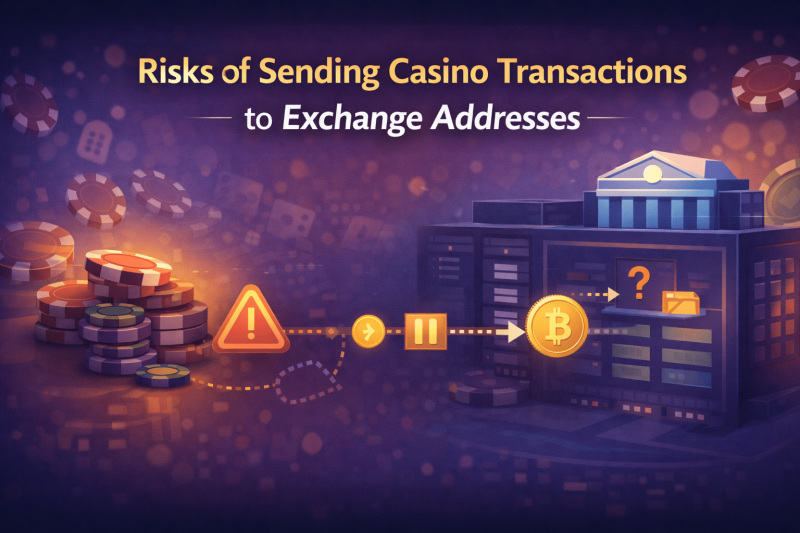
Sending casino deposits or withdrawals directly to an exchange address is one of the easiest ways for things to go wrong. It’s also one of the most common mistakes players make, often without realising there’s any risk involved.
The problem isn’t the blockchain itself. It’s how exchanges handle incoming and outgoing funds behind the scenes.
Why Exchange Addresses Create Problems
Most exchange addresses aren’t personal wallets. They’re often shared between many users, with the exchange relying on internal systems, memos, or tags to track who owns what. Casinos don’t have access to that internal accounting.
If a deposit is sent from an exchange and something doesn’t line up, the casino may see the transaction arrive on-chain but be unable to credit it to your account. From their side, there’s no clear way to prove ownership once the funds hit an exchange-controlled address.
This lack of visibility is where most problems start.
Deposit and Withdrawal Risks in Practice
Withdrawals carry similar risks. If a casino sends funds to an exchange address and a memo or tag is missing, incorrect, or delayed, the exchange may not credit the funds at all. At that point, the casino can usually only confirm that the withdrawal was sent.
Recovering the funds, if it’s possible at all, depends entirely on the exchange’s support process. Some exchanges can help, others can’t, and timelines can stretch out for weeks.
This is why many crypto casinos explicitly warn players not to use exchange addresses. It’s not because exchanges are unsafe by default, but because once funds enter an exchange’s system, casinos lose visibility and control. When something goes wrong, there’s often no simple fix.
Example: Casino Withdrawal Sent to an Exchange Without a Memo
A player requests a withdrawal from a crypto casino to their exchange account because their funds are already there. The casino processes the withdrawal and sends the funds on-chain successfully.
From the casino’s side, the transaction is complete. The blockchain shows the transfer as confirmed. But the exchange never credits the balance to the player’s account because the deposit required a memo or tag that wasn’t included.
At this point, the casino can’t reverse the transaction, and the exchange can’t automatically credit it. The player is told by the casino to contact the exchange, and the exchange asks for proof, screenshots, and transaction hashes.
If the exchange agrees to help, recovery can take weeks. In some cases, the funds are never credited at all.
When Using an Exchange May Cause Delays or Failed Deposits
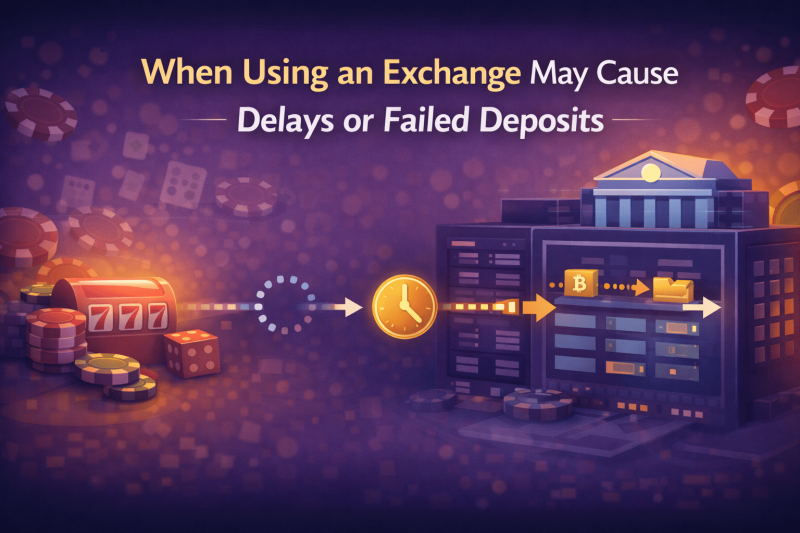
Even when a player follows instructions correctly, using an exchange can still introduce delays or failures that don’t occur with personal wallets. These issues usually come from exchange-side controls that casinos have no ability to see or influence.
The key difference is that exchanges manage transactions internally before and after anything appears on the blockchain.
Exchange-Side Controls That Slow or Block Transfers
Exchanges don’t always send withdrawals immediately. Requests can be queued, bundled, or paused internally before a transaction is ever broadcast. This is especially common during high-volume periods or when transfers are flagged for review.
When gambling sites are involved, some exchanges apply extra scrutiny. A withdrawal may sit pending without any on-chain record, even though the player has already initiated it. From the casino’s perspective, nothing exists yet to credit or investigate.
These delays aren’t errors, but they often look like one to the player because there’s no visible transaction to track.
Why Some Deposits Fail Even When Funds Are Sent
Failed deposits tend to happen when exchange handling doesn’t line up cleanly with how casinos expect to receive funds. Differences in network support, token formats, or required metadata can cause deposits to miss automatic crediting entirely.
In these cases, the funds may technically arrive, but without a clear link to the player’s casino account. Once that happens, resolution depends on whether the exchange can assist. The casino usually can’t correct or reverse how an exchange processed the transfer.
This is why exchanges are more prone to causing deposit issues, even when no mistake is obvious. The transaction path is simply more complex, with more points where things can quietly break.
Common Mistakes Players Make When Using Exchanges for Gambling

Most issues players run into aren’t caused by broken systems. They come from using exchanges in ways they weren’t designed for, especially once casino transactions are involved.
Treating Exchange Transfers Like Wallet Transfers
A common assumption is that sending crypto from an exchange works the same way as sending it from a wallet. In practice, it doesn’t. Exchange transfers are handled internally before anything reaches the blockchain, which adds steps the casino can’t see or control.
Players often only realise this when a deposit is delayed or a withdrawal doesn’t show up as expected. By that point, neither side can easily intervene.
Ignoring Casino Warnings About Exchange Use
Many crypto casinos clearly state that exchange accounts shouldn’t be used for deposits or withdrawals. These warnings are easy to skip past, especially when funds are already sitting on an exchange.
When a problem occurs after ignoring those warnings, recovery options are usually limited. Casinos may be able to confirm what happened on-chain, but they can’t resolve issues caused by exchange-side handling.
Sending or Receiving Funds Without Required Details
Exchanges often rely on extra information like memos, tags, or specific networks to process transactions correctly. Players who don’t double-check these requirements can end up with funds that arrive but aren’t credited.
Because this information is handled internally by the exchange, casinos usually can’t fix the issue once it’s happened.
Assuming Support Can Always Fix It Later
There’s a common belief that support teams can sort things out after the fact. In reality, casinos and exchanges operate independently. If funds are delayed, misrouted, or stuck inside an exchange’s system, casino support has very limited ability to help.
By the time a ticket is opened, the issue is often already outside the casino’s control.
Final Thoughts: Wallets vs Exchanges for Crypto Casino Play
Crypto exchanges and wallets both have their place, but they’re not interchangeable once casinos are involved. Most of the problems players run into come from using exchange accounts for something they weren’t built to handle.
Personal wallets keep transactions direct, visible, and under your control. Deposits credit more reliably, withdrawals are simpler, and there’s no third party in the middle deciding when or how funds move. Exchanges, on the other hand, add extra layers that casinos can’t see or influence, which is where delays and failed transactions usually start.
For casino play, the takeaway is straightforward. Exchanges are fine for trading and holding funds temporarily, but wallets are better suited for moving money in and out of gambling sites. Understanding that difference upfront can save a lot of frustration later.
FAQs – Crypto Exchanges vs Wallets for Casino Use
Is an exchange wallet the same as a crypto wallet?
Not really. An exchange wallet is more like an account balance backed by the exchange’s infrastructure. You can send and receive crypto, but you don’t control the private keys. For casino transactions, that difference matters because the exchange controls how and when funds actually move.
Why do crypto casinos prefer wallets over exchanges?
Because wallets make ownership clear. When a deposit or withdrawal involves a personal wallet, the casino can see exactly where funds came from and where they went. With exchanges, there’s an extra layer in the middle that casinos can’t see or control.
Can I deposit from an exchange if it’s quicker for me?
Sometimes it works, but it’s riskier. Even if the deposit arrives, delays, batching, or internal exchange handling can slow crediting or cause problems later. That’s why many casinos recommend using a wallet, even for small amounts.
Why do withdrawals to exchanges take longer?
Exchanges don’t always credit incoming funds instantly, especially if the transaction is linked to gambling. Withdrawals can be queued, reviewed, or held internally. Once the casino sends the funds, the timing is largely out of their hands.
Are hot wallets safe to use with crypto casinos?
Hot wallets are commonly used for casino play because they’re quick and easy to access. As long as you control the wallet and keep basic security in place, they’re generally fine for deposits and withdrawals. Cold wallets are safer for storage, but less practical for frequent play.
What happens if I send casino funds to the wrong exchange address or network?
In many cases, recovery is difficult or impossible. Casinos usually can’t reverse transactions, and exchanges may not be able to credit funds if details don’t line up. This is one of the biggest reasons players lose access to funds when using exchanges.
Is it ever okay to use an exchange with a crypto casino?
Exchanges make sense for trading or moving funds between assets. For casino deposits and withdrawals, wallets are usually the better option. Fewer steps means fewer things that can go wrong.