


RTP, volatility, and house edge get thrown around a lot in crypto casino games, but they’re rarely explained in a way that’s easy to apply. They each measure different things. One explains long-term returns, another explains balance swings, and the last explains why the casino always has an advantage. Looking at just one of them on its own usually leads to the wrong conclusions.
This page breaks down what each of these terms actually means, how they relate to one another, and why two games with the same RTP can feel completely different when you play them.
What RTP Really Represents in Casino Games

RTP, or return to player, is a long-term average. It’s not a promise about what will happen today, this week, or even this month. It’s a figure calculated over a huge number of bets, usually millions.
When a game lists an RTP of 96%, it means that over time, the game is designed to return about 96 cents for every dollar wagered. The key part there is over time. In real play, results jump around far more than that number suggests.
This is where a lot of confusion comes from. Players often look at RTP as a guide to short-term outcomes, but it doesn’t work that way. You can lose quickly in a high RTP game, or win big in a low RTP one, simply because short sessions are dominated by randomness.
RTP is best thought of as a baseline. It tells you how a game is built to behave in the long run, not how your next session is likely to go.
How House Edge Is Derived From RTP
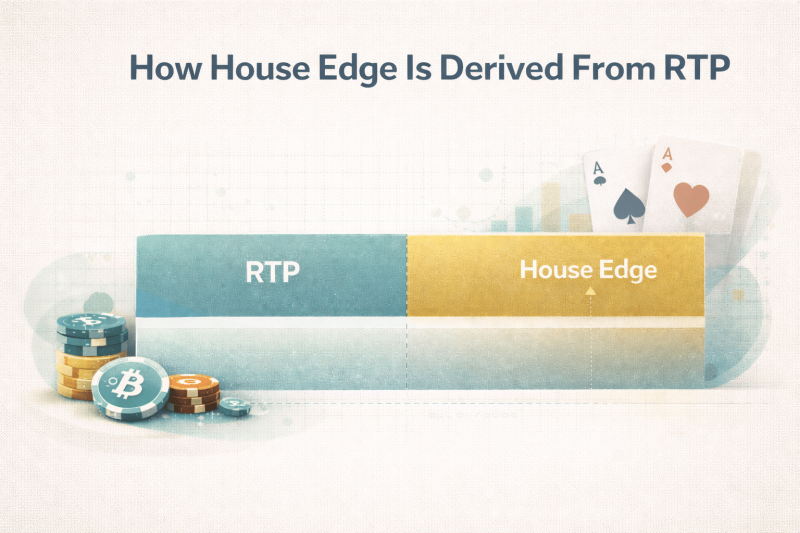
House edge is simply the casino’s side of the same calculation. If a game has an RTP of 96%, the remaining 4% is the house edge. That’s the built-in advantage the casino has over the player.
This doesn’t mean the casino takes 4% of every bet in a straight line. In the short term, results can swing in either direction. Over time, though, that edge is what keeps the casino profitable.
This is why house edge exists in every casino game, including crypto ones. Even games that feel fair or transparent are still designed to return slightly less than what players put in overall.
Understanding house edge helps set realistic expectations. A lower edge means better long-term value, but it doesn’t remove the risk of losing money in any single session.
Why Volatility Has More Impact Than RTP in the Short Term

Volatility describes how a game pays, not how much it pays back over time. It’s about how often wins happen and how big they tend to be.
Two games can have the same RTP and still feel completely different to play. One might pay out small amounts regularly, while the other goes for long stretches without a win and then hits much bigger payouts. That difference is volatility.
This is why RTP alone doesn’t explain what a session will look like. Volatility is what determines whether your balance moves slowly or swings hard. High volatility games can burn through a bankroll quickly, even with a high RTP. Low volatility games usually last longer but rarely produce big wins.
When players say a game feels “rough” or “swingy”, they’re usually talking about volatility, not RTP.
Low vs Medium vs High Volatility Games
Low volatility games tend to pay something back fairly often, but it’s usually small. Your balance moves around, but not in big jumps. They feel steadier, and sessions usually last longer, but you’re not likely to see anything dramatic.
Medium volatility is more stop-start. Wins don’t come as often, but when they do, they’re more noticeable. This is where a lot of popular games sit because it gives a bit of movement without things getting too wild.
High volatility games are the opposite. You can go a long time without hitting anything, then suddenly land a much bigger payout. That also means balances can drop fast if nothing lands. These games feel swingy for a reason.
None of this makes one type better than another. It just explains why some games feel calm, and others feel brutal, even before RTP comes into the picture.
How Different Volatility Levels Usually Feel
Different volatility levels tend to create very different sessions, even before RTP comes into play. The table below isn’t about rules or guarantees; it’s just a rough way to think about how these games usually feel once you start playing.
| Volatility level | How it usually plays | What sessions tend to feel like | Who it suits |
| Low volatility | Frequent small wins, few surprises | Steady, slower balance movement, longer sessions | Players who prefer consistency and don’t want big swings |
| Medium volatility | Wins come and go, payouts are noticeable but not huge | A mix of quiet stretches and short bursts of action | Players who want some movement without chaos |
| High volatility | Long dry spells with the chance of big hits | Swingy, unpredictable, fast balance changes | Players chasing bigger payouts who can handle losing runs |
Why Two Games With the Same RTP Can Feel Completely Different
This is where a lot of players get caught out. Two games can show the same RTP on paper and still play nothing alike once you start betting.
RTP only tells you how a game is expected to behave over a very long stretch of play. It doesn’t say anything about how wins are spaced out. That’s where volatility steps in. One game might drip-feed small wins, while another saves everything for the occasional big hit.
Because of that, one game can feel steady and forgiving, while another feels brutal, even though the maths behind them points to the same long-term return. Your balance doesn’t care about long-term averages; it reacts to what’s happening right now.
Most of the time, judging a game on RTP alone just leads to the wrong expectations. How a game feels is mostly about volatility, not the percentage listed in the info panel.
How RTP Behaves Over Short Play vs Long Play
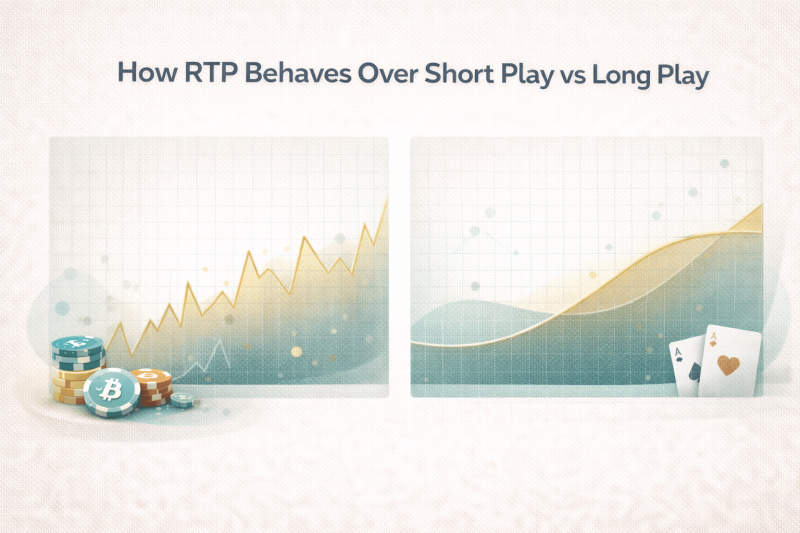
RTP doesn’t show up neatly in short sessions. A few spins or hands aren’t enough for the numbers to mean much, which is why early results can feel all over the place.
In the short term, games can run hot or cold for no clear reason. You might hit a run of wins, or you might lose quickly, even in a game with a high RTP. That’s normal, and it doesn’t say much about the game itself.
Over a much longer stretch of play, things start to settle closer to the listed RTP. Big swings still happen, just less often. The average slowly pulls things back toward where the game is designed to sit.
Most confusion comes from expecting RTP to describe what happens in a single session. It doesn’t. It only starts to matter once you zoom out far enough.
RTP and Volatility Across Different Game Types
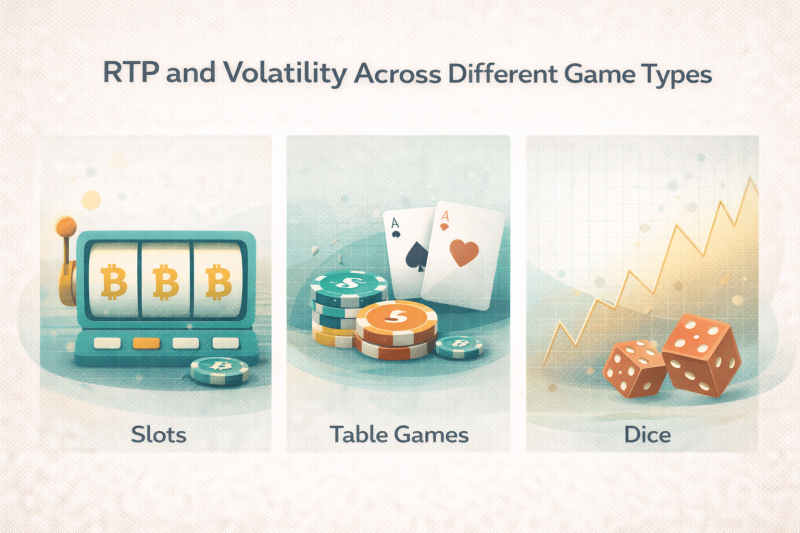
RTP doesn’t behave the same way across every casino game. A number that looks fine in one game can feel completely different in another, once you start playing.
That’s because games pay in different patterns. Some drip out small wins, some save everything for the occasional hit, and some can swing hard in either direction. The RTP might be similar, but how you experience it depends on the type of game you’re in.
Below, we’ll look at the most common game types you’ll see in crypto casinos, like pokies, table games, and crash or dice-style games, and how RTP and volatility tend to play out in each. The numbers might look similar on paper, but the way they show up during play often isn’t.
Pokies
Online pokies are where RTP and volatility are easiest to misunderstand. A slot can list a solid RTP and still empty a balance faster than expected, simply because of how uneven the payouts are.
Most pokies are built around long dry spells broken up by occasional wins. In low volatility pokies, those wins show up more often but don’t move the balance much. In higher volatility pokies, wins are rarer, but when they land, they’re bigger and more noticeable.
This is why two pokies with similar RTPs can feel completely different. One might keep you ticking along with small hits, while another does very little until something finally connects. The RTP hasn’t changed, but the path to getting there has.
Features like bonus rounds and free spins also play a role. A lot of a slot’s RTP is often tied up in these features, which means a session can feel flat if they don’t trigger. When they do, they can make the same game feel generous.
pokies aren’t unpredictable because the maths is broken. They feel unpredictable because of how their payouts are spaced out.
Table Games
Table games usually feel calmer than pokies, even before you look at any numbers. Wins and losses come more steadily, and your balance doesn’t tend to jump around as much from one moment to the next.
Instead of long dead periods or sudden spikes, things move in smaller steps. You might win a bit, lose a bit, then win again. That slower pace is why table games often feel easier to sit with over longer sessions.
RTP still matters, but it shows up differently here. You’re not waiting on features or bonus rounds to unlock most of the returns. What happens is more immediate, which makes results feel less random, even though the maths is still doing the same job in the background.
Small rule differences can also change how a table game feels. Two versions of the same game can play differently just because of payouts or table rules, even if the RTP numbers are close.
Table games aren’t safer or fairer. They’re just less jumpy, which is why some players prefer them once they’re tired of the swings you get with pokies.
Crash and Dice-Style Games
Crash and dice-style games don’t really feel like pokies or table games. They sit in their own lane, and the way RTP and volatility show up can change a lot depending on how you play them.
Some versions are set up to return small amounts often. You might cash out early, see frequent wins, and feel like things are ticking along nicely. Others push everything toward rare, high multipliers. Those sessions can be quiet for a long time, then flip suddenly if a big result lands.
What makes these games different is that the volatility isn’t always fixed. How aggressive you are with cash-outs or targets can change how the game feels from one session to the next, even though the underlying RTP stays the same.
That’s why two players can have completely different experiences in the same crash or dice game. One might see steady returns, while another runs into sharp swings, all without the maths changing underneath.
These games make the gap between RTP and real-world experience especially obvious. The numbers stay constant, but the way they play out can vary a lot.
Common Misconceptions About RTP and “Fair” Games
One of the biggest misunderstandings is treating RTP like a forecast. A high RTP doesn’t mean a good session is coming, and a low RTP doesn’t mean you’re guaranteed to lose quickly. It’s a long-term number, not a short-term promise.
Another common mix-up is assuming “fair” means favourable. A game can be provably fair, transparent, and working exactly as designed, and still be stacked in the casino’s favour. Fair just means the rules are followed, not that the odds are kind.
Volatility also gets overlooked. Players often blame bad luck or a low RTP when a session goes badly, when in reality they’re just feeling the effects of a high volatility game doing what it’s built to do.
There’s also a tendency to compare games too directly. Two games with similar RTPs can feel nothing alike, especially across different game types. Without factoring in volatility and house edge, those comparisons usually fall apart once you start playing.
Most of the frustration around casino games doesn’t come from hidden mechanics. It comes from expecting these numbers to describe something they were never meant to describe.
Putting RTP, Volatility, and House Edge Together
Once you look at a few different games side by side, it becomes clear why these numbers cause so much confusion. RTP, volatility, and house edge aren’t trying to answer the same question, but they often get treated like they are.
RTP is about how a game is built to behave over a very long stretch of play. It doesn’t care what happens in one session, or even a handful of sessions. That’s why a game can look good on paper and still feel rough when you sit down and play it.
House edge is simpler, but easier to ignore. No matter how transparent or fair a game claims to be, the maths still leans slightly toward the casino. Sometimes that edge is small enough to barely notice in the short term, sometimes it isn’t, but it’s always there in the background.
Volatility is what most players actually feel. It’s the reason some games seem calm and others feel punishing. You can be playing a perfectly normal game and still see long losing runs or sudden jumps, just because of how the payouts are spaced out.
When you put all three together, a lot of things start to make sense. Losing quickly doesn’t automatically mean a game is bad. Winning big doesn’t mean the odds have changed. It usually just means you’re seeing the short-term swings before the long-term averages have any chance to show up.
Understanding this doesn’t make gambling safer or more profitable. It just makes it less confusing. You stop expecting these numbers to predict outcomes, and start seeing them for what they are: rough guides to how a game is designed to behave over time.
FAQs – RTP, Volatility, and House Edge
Does a higher RTP mean a better chance of winning?
Not really in the way most people think. A higher RTP just means the game gives more back over a very long run. It doesn’t stop you from losing quickly if things don’t go your way early on.
Why do some high RTP games feel so rough to play?
Because the wins are spaced out. You can be playing a perfectly normal game with a decent RTP and still hit long dry spells if it’s volatile. That’s usually what people are feeling when a game seems “bad”.
Is low volatility safer than high volatility?
Safer isn’t quite the right word. Low volatility just means things move more slowly. You’ll usually see smaller ups and downs, but you’re still losing and winning under the same maths.
Can two games with the same RTP really behave that differently?
Yes, and it catches people out all the time. One game might chip away at your balance slowly, another might do nothing for ages and then pay out all at once. The percentage doesn’t show that part.
Does house edge change during a game?
No. It doesn’t shift based on streaks or results. It’s built into the game from the start. What changes is how obvious it feels while you’re playing.
Are provably fair games better in terms of RTP or volatility?
They’re not better or worse in that sense. Provably fair just means the result wasn’t messed with after the bet. The odds and payout patterns are still whatever the game was designed to have.
Should I choose games based on RTP alone?
It helps, but it won’t tell you how a session is going to feel. Volatility and game type usually matter more once you actually start playing.